
Sarpsborg Municipality: Safer Nights with Digital Monitoring
By implementing digital monitoring in home care and in residential facilities, the municipality of Sarpsborg has reduced unnecessary nighttime emergency calls, used its resources more efficiently, and laid the groundwork for safer and more gentle patient care.
Photo: visitoestfold.com
The municipality of Sarpsborg is actively working to implement digital solutions that can improve the quality of health and social care services while ensuring that resources are used more efficiently. In both home care and residential care facilities, the municipality has long recognized the need for more flexible and less intrusive ways to conduct night-time checks— especially at night.
Previously, nighttime checks often involved physical visits, even in situations where the patient was, in fact, sleeping peacefully. This could lead to disrupted sleep for patients and an unnecessary use of staff time. At the same time, long distances in home care meant that a lot of time was spent driving, rather than providing care where the need was actually greatest.
To address this need, the municipality has implemented digital monitoring. The solution provides staff with a better basis for decision-making in their daily work and enables them to assess situations before dispatching personnel. This helps reduce unnecessary call-outs and ensures better use of available resources. The goal is to spend time where it adds the most value, while also ensuring gentler and safer care for patients, even at night.
The Big Challenge
Before the introduction of digital monitoring, the municipality of Sarpsborg found that many nighttime monitoring visits involved physical visits that, in practice, did not reveal a need for intervention. Patients were often woken up when staff unlocked the door to conduct inspections, which led to disrupted sleep and anxiety.
At the same time, the in-person checks meant that home care services spent a lot of time driving, including to addresses that were far away. This affected how resources could be prioritized.
Tellu's Solution
Today, the municipality of Sarpsborg uses two different digital monitoring solutions from Tellus, tailored to different applications.
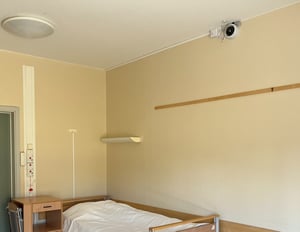
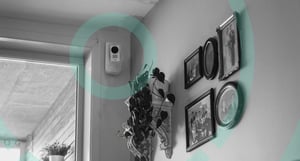
In home care services, simpler cameras are used that can be quickly deployed as needed. These are primarily used for monitoring in the evenings and at night. In care facilities, more advanced cameras are used for permanent installation over time, both for monitoring and for alerting staff in the event of incidents.

Peace of Mind Through Accessibility
"If you submit a request, you'll quickly receive help from people who are eager to assist you. Plus, they'll follow up with you—which gives you peace of mind."
Close follow-up ensured a smooth transition
During the implementation phase, close dialogue and accessibility have been crucial. For the municipality of Sarpsborg, it has been important to feel supported both during training and in the day-to-day use of the solution.
“If something is urgent, we can call directly. At the same time, we feel that we’re being supported over time, which gives us peace of mind,” says Nilsen.
Thorough training and ongoing follow-up have made it easier for employees to adopt the solutions in their busy workdays and have lowered the barrier to actively using digital supervision.
RESULTS
AND PRIZES
By reducing unnecessary nighttime inspections, the municipality of Sarpsborg has improved the efficiency of its resource allocation and gained more time to focus on follow-up where the need is actually greatest.
Saves time during the night shift
More efficient use of resources
Fewer unnecessary
physical responses
Better and more gentle
service for patients

For the municipality of Sarpsborg, the transition to digital inspections has yielded clear practical benefits, especially at night. Previously, the municipality conducted several nightly inspections at locations that were far apart, a practice that can now be significantly reduced.
“This saves us a lot of time,” says Nilsen.
Although the municipality has not yet completed quantified measurements for larger projects, the experience on the ground is clear: Resources can be used more effectively, and staff gain a better overview of patients’ needs.
Going forward, Sarpsborg Municipality has a clear goal of shifting from fixed-schedule visits to more event-based visits. As the cameras capture more information, this paves the way for more precise and preventive follow-up.
“As staff become confident that the monitoring captures relevant situations, they’ll be able to allocate their time differently, ” explains Nilsen.
The municipality also sees great potential in the continued use of more intelligent monitoring, particularly in relation to fall detection—an area they plan to continue working on.
“Patients will feel confident that they’ll be taken care of when something actually happens,” he concludes.
Sarpsborg Municipality is located in Østfold County and has a population of approximately 60,600. The municipality is one of Norway’s oldest cities and was founded in 1016 by Olav Haraldsson.
Sarpsborg Municipality is responsible for a wide range of services, including health and social care, and is actively working on digitization and the development of future-oriented welfare services.
Sources: sarpsborg.com, ssb.no, and snl.no.
Sarpsborg Municipality has approximately 60,600 residents.
Founded in the year 1016 by Olav Haraldsson (the Holy).
It has a land area of approximately 370 km².
It is the third-oldest city in the country, after Tønsberg and Nidaros.
The first part of the town’s name, the waterfall name “Sarpr,” means “bird’s nest” in Icelandic. Another interpretation is that the first part means “the one who swallows.” The rest of the name is linked to St. Olav’s fortress, which he built next to the waterfall.
In the Middle Ages, it was the seat of Borgarting, one of Norway's most important assembly sites.

Would you like to learn more or place an order?
Frequently Asked Questions
We know that lives and health are at stake at every stage of the value chain, and we take uptime and response time very seriously.
Even though we’ve chosen top-tier suppliers, technical issues can of course arise. If the problems are related to installed equipment, it can be replaced just as easily as when it was first installed. As a rule, municipalities prefer to keep a few extra TelluVision packages in stock, but if they don’t, we’ll ship or deliver new equipment as soon as we receive a request.
If the issue relates to the software or the Tellu platform, we’ll detect it very quickly ourselves and do everything we can to resolve the problem.
Although the data stored is minimal, the data that is stored will be accessible through secure login and access for relevant healthcare professionals, in the same way as other health data associated with the Tellu platform.
There are three things we’re particularly proud of with this solution: how easy it is to set up and start using, the high-quality technology built into the equipment itself, and the proprietary software that provides a level of accuracy in measurements and situational assessments that no one else can match.
This means that it’s easy to install and verify that it works, that the images and audio are very high-resolution, and that the user-friendliness, effectiveness, and results are both reliable and measurable.
TelluVision for Home Residents will function seamlessly as a new component of the TelluCare system.
Based on experience, one unit per living unit is often sufficient, but in some cases two may be needed—this depends on the size of the living unit and the typical movement patterns and habits of the person(s) being monitored. Typical installation locations are bedrooms or living rooms, but the system can be installed anywhere.
Yes, you can. By registering as trial users of TelluVision for Home Care, you will gain access to monitoring data on the TelluCare platform on the same terms as other municipalities/users for active monitoring, reporting, and analysis.
In practice, edge computing means that data is processed in the device that captures it BEFORE it is sent to a central platform. This could mean, for example, that video is compressed or processed before it is sent to a central cloud solution. This saves time, energy, and reduces environmental impact, as the amount of data that needs to be uploaded and downloaded is reduced. It also enhances data security, since there is less data that can be intercepted during transmission.
Tellus’ AI algorithms for detecting falls, the movement of heavy objects (such as people, furniture, or other items), and analyzing the severity of a potential hazardous situation are based on years of empirical data from our internal resources, large volumes of collected and analyzed data, and finely tuned parameters from our technicians. The solution will continue to be refined based on anonymized log data (e.g., whether what was detected was an animal or a person, furniture, or something else, etc.) to steadily reduce the rate of false alarms.
Since TelluVision for Home Residents is connected to the TelluCare platform, it uses the same alert mechanisms. These may include mobile alerts and push notifications or other channels, set up as agreed.
TelluVision for Home Residents requires no resources from the IT department, no integrations with other systems, no electricians or other installers, and no prior training. The all-in-one solution is very simple, takes only ten minutes to install (without the use of a drill or glue), and requires no further maintenance. The only thing required is a change in the routines of home health aides, who will free up a lot of time.
TelluVision for Home Residents provides alerts for falls, unusual or unnatural movements, breathing difficulties, agitation, or inactivity, and more.
After three months, use of TelluVision for Home Residents transitions to a combined model consisting of an equipment purchase and a low monthly fee/subscription to remain connected to the TelluCare platform.
If you choose to receive support from the response center, you will be billed on an ongoing basis.
Please contact us for further information.
Contact Us
Would you like to learn more about how TelluVision for Home Residents works, or would you like to try out the system completely free of charge for three months for your municipality or business?
We’re here to answer your questions and help you.